Himachal Pradesh: Snow Peaks, Valley Roads & the India That Resets You
P
Priya Sengupta
28 March 20258 min read
Shimla's Mall Road, Manali's glacier valleys, McLeod Ganj's Tibetan temples, Khajjiar's meadows, and Spiti's high-altitude moonscapes — the complete guide to Himachal Pradesh.
Himachal Pradesh is the mountain state India keeps discovering anew. The same roads that carry honeymooners to Shimla in May carry backpackers to Kasol in June, monks to Dharamshala in August, and motorcycle tourers across Spiti in September. The state accommodates all of them, largely without complaint. Its ranges, rivers, and apple orchards have a way of resetting even the most frantic traveller.
Shimla — The Hill Station That Set the Standard
Shimla was the summer capital of British India for good reason — at 2,200 metres, it provided relief from the plains heat while retaining the administrative infrastructure of an empire. The Mall Road and Ridge remain the social heart of the city, lined with colonial-era buildings that have survived remarkably intact. The Christ Church on the Ridge is one of the finest neo-Gothic structures in India. The UNESCO-listed Kalka–Shimla narrow-gauge railway, threading through 103 tunnels and across 864 bridges in 96 kilometres, is one of the great heritage train journeys on the subcontinent.
Khajjiar — the meadow that earned the 'Switzerland of India' label, and it is not entirely undeserved.
💡
Pro Tip: Khajjiar near Dalhousie is best visited in October–November when the deodar forest turns gold and the meadow is free of monsoon mist. The 22km road from Dalhousie is an excellent half-day drive even without stopping at Khajjiar itself.
Manali — The Valley That Does Everything
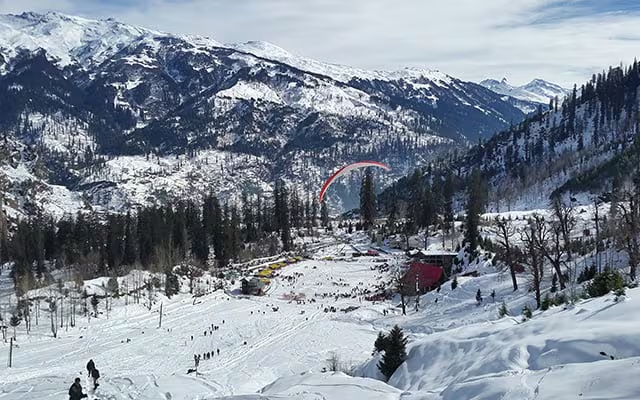
Manali operates at two speeds simultaneously. The old town around Manu Temple and the Hadimba Devi Temple — a five-storey pagoda temple built into the deodar forest in 1553 — is quiet, wooded, and surprisingly spiritual. The new town is ski gear, paragliding operators, and cafés playing Bob Marley. Solang Valley, 14 kilometres north, is the adventure hub — rope courses, zorbing, and winter skiing. Rohtang Pass (51 km, open May–October) provides the first real taste of high-altitude Himalaya: snow fields, freezing wind, and a view down into the Lahaul Valley that justifies every rupee of the permit.
Solang Valley above Manali — snow activities in winter, paragliding and trekking in summer.
Dharamshala & McLeod Ganj — Where Tibet Meets the Himalaya
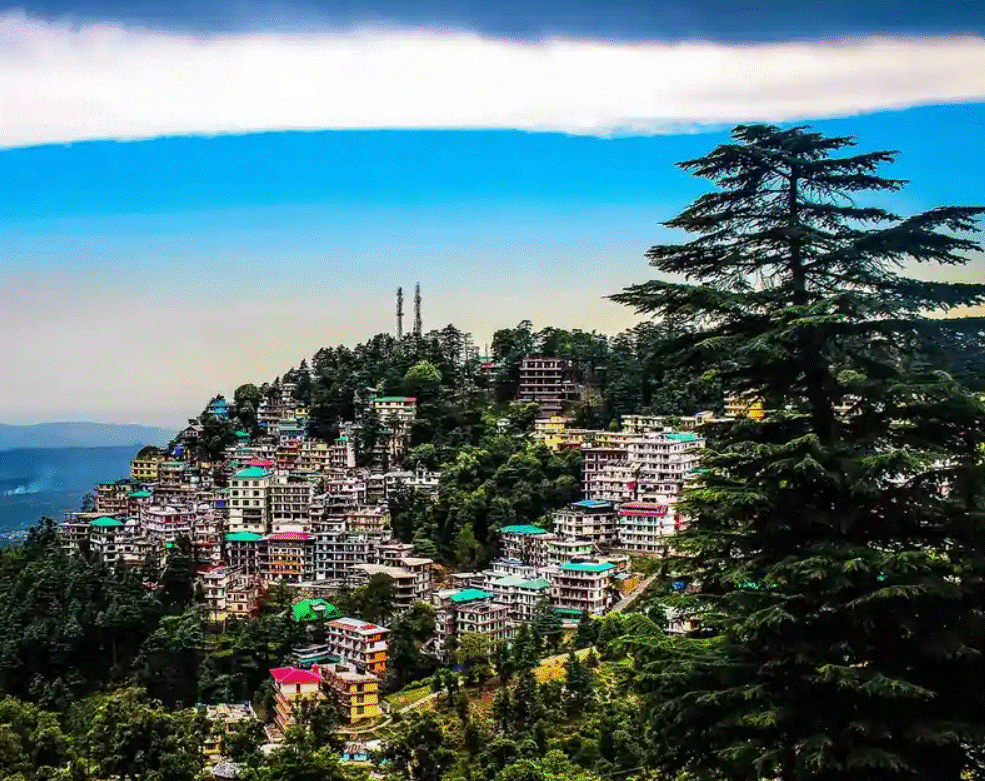
McLeod Ganj is unlike anywhere else in India. Since the Dalai Lama established the Tibetan government-in-exile here in 1960, the upper hill station has developed a remarkable dual identity — Tibetan monasteries, butter tea shops, and mani stone walls alongside an international backpacker community drawn by the combination of trekking, meditation, and Tibetan Buddhism. The Namgyal Monastery adjoining the Dalai Lama's residence is open to visitors. Triund Trek (18 km return) gives a ridge-top view of the Dhauladhar range that is among the most accessible high-altitude views in India.
McLeod Ganj — Tibetan prayer flags over the Dhauladhar range, a combination found nowhere else in India.
Spiti Valley — The High-Altitude Moonscape
Spiti is not for every traveller, and that is part of its power. At 3,800–4,500 metres, this cold desert valley between India and Tibet is accessible only from June to October (the Rohtang and Kunzum passes close with snow). The key Ki Monastery clinging to its hilltop, the mud-brick village of Kibber (once the world's highest motorable village), and the fossil fields of Langza reward those willing to accept altitude sickness as a possible side effect of admission. Book accommodation well in advance — options are limited and fill quickly.
Spiti Valley — a cold desert at 4,000 metres that feels like the edge of the world. It partly is.